The proposal looks reassuring. There is an audit, a keyword list, a content calendar and a monthly report. There may even be a separate package for getting your business mentioned in AI answers.
Then comes the question that should have been answered on page one: what, exactly, are you paying this company to improve?
A local contractor needs enquiries from people inside a service area. A software company needs prospects who understand the product and can buy it. A subscription platform needs visitors who make it through registration and payment. Those businesses might all need SEO, but they should not receive the same plan.
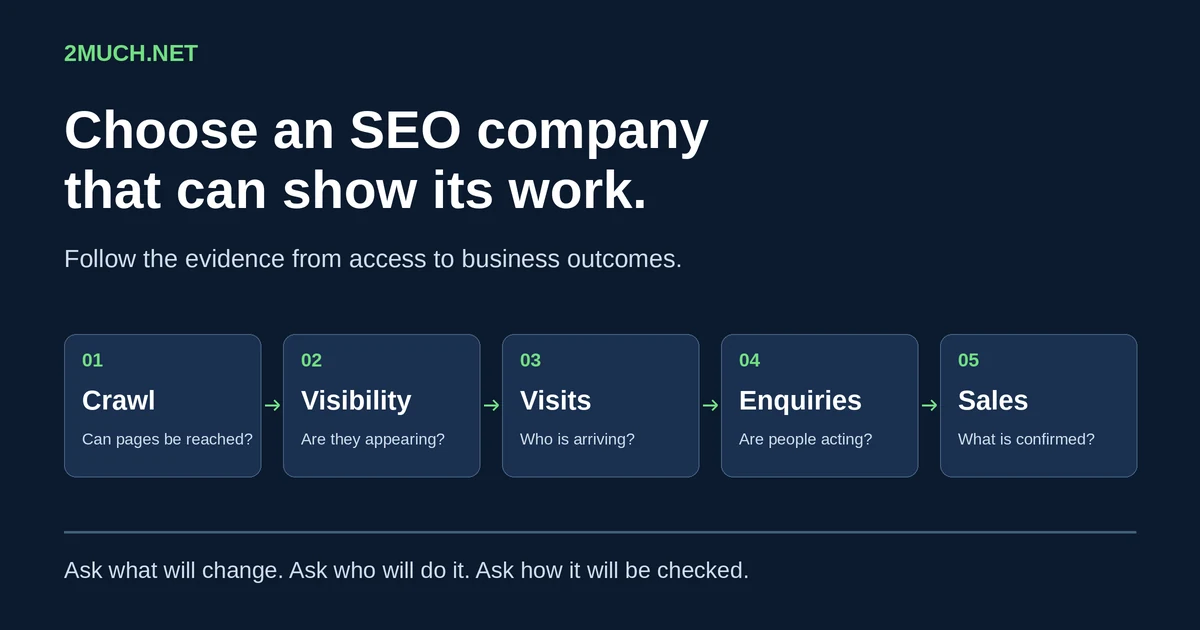
Choose an SEO company by the quality of its diagnosis, its ability to implement useful changes, and the evidence it uses to judge results. Ask for a defined scope, an implementation owner, access to your own data, and reporting that connects search performance to a business goal. A confident sales presentation cannot substitute for those things.
Define the job before you compare SEO companies
Start with a short brief in ordinary language. What do you sell? Who buys it? Where do you operate? Which action on the website has real value? What seems to be going wrong?
“We need more traffic” is a starting point. “We need more qualified enquiries for commercial installations in southern Ontario” is a brief someone can work with. It gives the agency a customer, a service, a geography and an outcome.
Include practical constraints. If your developers can only release changes once a month, say so. If the website is moving platforms, mention the migration. If checkout happens on another domain, put that in the brief. Otherwise, you can end up paying for recommendations that nobody can deploy or measure.
| Your situation | Support worth considering | What to confirm |
|---|---|---|
| A small service website with a narrow problem | An experienced consultant or a focused project | Who fixes the pages, and whether local search is in scope |
| A redesign, migration or complex catalogue | A technical SEO specialist working with your developers | URL mapping, template testing, release checks and recovery plans |
| Ongoing publishing and several markets | An agency with editorial, technical and analytics capacity | The actual delivery team, subject expertise and implementation hours |
| An internal team that can make changes | Software plus periodic specialist review | Data quality, prioritisation and a person accountable for decisions |
Company size is a poor shortcut for competence. A good independent specialist may be ideal for a technical problem. A broader agency may be useful when the work spans research, writing, design and development. Ask to meet the people who would handle your account.
What does a good SEO company actually do?
A useful engagement covers the parts of search that matter to your business. It should be possible to describe each workstream without leaning on a proprietary score.
Technical access and website structure
Can search engines retrieve the important pages? Are the intended pages indexable? Do redirects, canonical URLs, navigation and sitemaps agree? Does the content exist in a form a crawler can interpret? Can a visitor use the page comfortably on a phone?
On a larger platform, a single template error can affect thousands of URLs. On an access-controlled site, a login wall, age gate or security challenge can change what the crawler receives. Those problems need investigation at the application and hosting layers. Our guide to server-level SEO problems explains why a content-only audit can miss them.
Search demand and content
Keyword research should explain what prospective customers need and which page should serve that need. Ask how the provider distinguishes a buyer researching a service from someone looking for a definition, a job or a free download.
The resulting work may involve improving a service page, consolidating overlapping articles, adding an honest comparison, or making existing expertise easier to find. A quota of new blog posts is a production target. Its commercial value still needs an explanation.
Page presentation and structured data
Titles, headings and descriptions should help people recognise a relevant result. Internal links should lead readers to useful next steps. Structured data should describe the actual content, with accurate author, business, product or article details.
A schema validator cannot decide whether the claims are true. Someone still needs to compare the markup with the page. See our practical guide to schema for SEO for examples of that distinction.
Relevant authority and local visibility
For a local business, the work may include accurate business information, useful service-area pages and a well-maintained business profile. For a specialist publisher or software company, it may involve original research, documentation, partnerships and coverage from relevant publications.
Ask what the provider plans to earn attention for. Buying a quantity of links is much easier to quote than building something another website has a reason to reference.
A paid SEO audit should leave you with decisions
An automated crawl can produce hundreds of warnings before lunch. The value of an audit is deciding which findings matter, checking that they are real, and turning them into work someone can carry out.
For every significant recommendation, ask for:
- The affected pages or template. Include examples and a sensible estimate of scope.
- The evidence. A response, a rendered page, an inspection result, a data export or another record that supports the finding.
- The likely consequence. Explain how this could affect discovery, relevance, usability or a commercial action.
- The proposed change. Describe the work clearly enough for a developer or editor to estimate it.
- Priority and ownership. State who will do it, the dependencies and why it deserves attention now.
- Verification. Specify how the team will check the live result and what later measurement can establish.
“Improve canonicalisation” is too vague. “These two listing routes serve equivalent content; choose the intended route, align internal links and canonical signals, then verify representative URLs and monitor the combined page group” is a usable recommendation.
It is reasonable for discovery to uncover more questions. The audit should identify those gaps openly. An assumed cause belongs in an investigation plan until the evidence supports it.
Questions to ask before hiring an SEO company
You do not need to catch an agency out with obscure technical trivia. Ask questions that reveal how it works when the evidence is incomplete or the website is difficult to change.
- What would you investigate first, and why? Look for questions about customers, valuable pages, measurement and recent releases before a long list of deliverables.
- Can you show a comparable project? Ask about the starting condition, actual changes, measurement period and limitations. A redacted example is fine.
- Who would work on this account? Find out who diagnoses problems, who writes, who implements and who checks the result.
- What is included in implementation? Separate recommendations, coding, editorial work, quality assurance and coordination with your team.
- How do you choose which pages to improve? A useful answer considers business value, search intent, current evidence and effort.
- What happens when you disagree with an audit tool? Ask for an example of a warning they checked and decided not to act on.
- How will you measure progress? Require definitions for the main metrics, the baseline, the reporting scope and the data-through date.
- How will I see what changed? Ask for a change log with affected URLs, deployment dates and live verification.
- What would make the result inconclusive? Sparse data, overlapping releases and broken tracking are normal problems. A competent provider can discuss them.
- What will I retain if we stop working together? Confirm access to accounts, source files, content, reports and implementation records.
Then speak to a reference. Ask whether the provider completed work reliably, explained setbacks and left the client in control of its website. A dramatic growth chart tells you little about those everyday responsibilities.
How to evaluate AI SEO, AEO and GEO services
AI SEO, answer engine optimisation (AEO) and generative engine optimisation (GEO) are labels used for work intended to improve a business’s visibility in AI-generated answers. The scope varies considerably. Have the provider name the systems it is targeting and the changes it proposes.
For Google AI Overviews and AI Mode, Google says a supporting page must be indexed and eligible for a search snippet. It does not require special AI markup or an additional AI text file. Those points come directly from Google’s guidance on AI features. A vendor claiming a mandatory “AI schema upgrade” should be able to explain its evidence.
Look for specific editorial and technical work
An AI-search proposal can reasonably include checking access to public pages, improving product explanations, publishing useful comparisons, identifying authors, linking to original evidence and keeping business facts consistent. Original examples and clear limitations give both readers and retrieval systems something concrete to work with.
Ask to see the proposed page improvement. A rewritten answer to a real customer question is reviewable. “Increase your AI authority” needs a much more precise description before it belongs in a contract.
Ask how visibility will be sampled
An AI mention, a linked citation, a referral visit and a sale are different observations. For a recurring visibility check, agree on the questions, platforms, dates, language, location where relevant and whether the answer linked to your website. Save enough context to reproduce the method.
Answers can vary between runs. A small prompt set is a sample of responses under stated conditions; it is a weak basis for claiming a market-wide share of visibility. Ask how the provider handles changes in the test set and results that do not repeat.
Google includes its AI-feature traffic in Search Console’s overall Web reporting. That reporting alone does not isolate an AI Overviews uplift. Google explains the reporting here. Other answer services have their own access and reporting arrangements; do not assume a rule for Google applies to all of them.
Finally, discuss which public pages you want available to which systems. Useful marketing pages, private account content and paid material have different purposes. An AI visibility project needs an explicit content-access policy.
What our own search-data investigations have taught us
Working on AutoSEO reporting and the SmarterSEO investigation workflow has made us more demanding about the stories attached to charts. The following lessons come from internal investigations and product reviews. Client identities and private figures are omitted.
One losing URL can hide a healthier page group
We have examined a sharp decline on a listing URL while an equivalent, preferred URL began receiving the clicks. Reporting only the old route made the situation look much worse than the combined result.
The hiring lesson: ask how the agency groups equivalent pages and checks Google’s selected canonical before declaring a loss. A falling URL is a useful clue; you still need to know where its audience went.
A fall in total traffic can belong to another channel
In another investigation, a large all-traffic decline was concentrated in the end of an unusual Direct-attributed surge. The Google organic series did not show the same collapse. That changed the question we needed to investigate.
“Direct” is an attribution label. It did not, by itself, identify the visitors, prove a bot problem or explain sales. A good SEO company should separate the channel evidence from those unanswered questions before proposing a recovery campaign.
A healthy site total can conceal a valuable group losing traffic
We have also seen page groups decline while gains elsewhere kept aggregate traffic steady. A homepage gain can coexist with a loss on pages closer to a purchase.
That is why the report needs commercially meaningful page groups. It also needs actual conversion or sales evidence before anyone claims that a particular traffic shift caused a revenue change.
A working import is only one part of reliable measurement
Our capability reviews distinguish code that exists, data that has arrived, and a workflow that has been validated end to end. Configured property IDs do not establish fresh coverage. A revenue field in a dashboard does not establish that it reconciles with the payment system.
Ask a prospective provider to show data completeness and explain missing values. A blank, a stale observation and a measured zero should lead to different decisions. This sounds like housekeeping until a misleading comparison consumes a month of work.
What should an SEO company report each month?
A useful report should help you decide what to do next. Keep a short business overview, then provide enough detail to check its conclusions.
| Question | Evidence to request | What to watch for |
|---|---|---|
| What work reached production? | Changed URLs or templates, dates and live checks | A completed recommendation counted as a deployed fix |
| Did relevant search visibility change? | Queries and page groups, clicks, impressions, CTR and position | Brand growth hiding weak acquisition of new customers |
| Did useful visits change? | Landing pages, channels and relevant device or market segments | All traffic presented as Google organic traffic |
| Did the business benefit? | Qualified enquiries, verified purchases or other defined outcomes | A form click labelled as a sale |
| How complete is the evidence? | Sources, filters, time zones, coverage and latest complete dates | Missing days treated as zero or compared with full periods |
| What happens next? | A prioritised decision, owner and reason | Another month of the same activity without reassessment |
Separate visibility from the value of the visit
A rising impression count may reflect broader exposure, a changed query mix or more appearances in low positions. A lower click-through rate may accompany that broader exposure. Read those metrics together, then inspect the relevant searches and pages.
For example, a fictional page with 20,000 impressions and 120 clicks has a 0.6% CTR. That figure alone cannot tell you whether its title is poor. You would want to know its positions, query intent, devices and result context before rewriting it. This is an illustration, not a client benchmark.
Respect the boundary between query data and sales data
Search Console provides aggregate query and page evidence. Linking it to GA4 does not create an observed connection between an individual organic search phrase and a purchaser. Google’s Search Console integration documentation describes the available reports and compatible dimensions.
Landing-page revenue can be useful when its acquisition and transaction measurement are validated. Assigning that revenue across the page’s organic keywords introduces modelling assumptions. If a report does this, it should explain the method and label the output as an estimate.
For subscriptions, distinguish new customer payments from renewals and account for refunds. Reconcile revenue with billing for the same scope, period and currency. Keep the unattributed portion visible.
Ask whether the work caused the improvement
Record the deployment date and compare complete periods with similar weekdays. Check seasonality, promotions, pricing, tracking changes, outages and other releases. Use a suitable comparison group where feasible, and explain its limitations.
If five things changed in the same week, the later traffic increase does not identify which one helped. A sensible report can say that an improvement followed a release while reserving judgment about causation. Our article on measuring the effect of an SEO change explores that problem in more detail.
For the underlying reporting workflow, see using GA4 and Search Console to improve SEO. Google also explains why search clicks and analytics sessions can differ; expecting identical totals creates unnecessary confusion.
How much should SEO cost, and what should the contract cover?
Price follows the job. A one-off technical investigation, monthly advisory support and an agency managing content plus development have different labour requirements. Compare proposals against the same scope before comparing the monthly fee.
Ask for the audit cost, ongoing delivery, implementation allowance, content responsibilities, third-party costs and any excluded development. Check who pays when an apparently small recommendation requires a template rebuild.
Use your own economics to test affordability. As a purely illustrative calculation, a US$2,000 monthly programme would need ten additional sales to cover that fee if each sale contributes US$200 after variable costs, before other programme expenses. Those are invented planning figures, not typical SEO prices or a forecast. In a recurring business, model customer value over a stated period and keep acquisition timing visible.
The contract should identify deliverables, responsibilities, reporting access, approval arrangements, cancellation terms and handover. Retain ownership of your domain, website, analytics and search accounts. Grant the access required for the agreed work, and remove it when the engagement ends.
An initial diagnostic review can usually begin with read access to reporting. Production changes require a clearer arrangement: named responsibilities, a record of what changed, a verification process and a way to recover if the release goes wrong.
Be especially clear about the boundary between advice and delivery. If your developers implement the recommendations, reserve their time. If the agency implements, put that work in the scope. An untouched audit has limited value however good its analysis may be.
SEO promises that deserve a closer look
A strong sales claim should become more precise when you question it. These claims often become less convincing.
- Guaranteed first place. Ask which query, location, result type and date. Rankings and third-party answer systems are outside an agency’s control. Google cautions against ranking guarantees in its guide to hiring an SEO.
- Guaranteed placement in AI answers. Ask whether the promised result is a mention, citation, paid placement or something else, and how it will be verified.
- A fixed quantity of paid ranking links. Ask where they come from and how the arrangement works. Google’s link-spam policy covers buying or selling links for ranking manipulation.
- Large volumes of near-identical pages. Ask what each page contributes for the reader. Google’s scaled-content abuse policy applies to content produced primarily to manipulate rankings, regardless of how it was created.
- Secret changes you cannot inspect. A proprietary analysis method can coexist with a clear record of work performed on your website. You need the latter.
- Every decline blamed on an algorithm update. Ask about affected pages, channels, dates, demand and technical history. Google’s traffic-drop troubleshooting guide covers several possible causes.
- A dashboard that cannot be reconciled. Ask for the underlying period, filters and source. A persuasive percentage needs a checkable denominator.
Also separate advertising from organic SEO in the proposal and report. Each can have a place in acquisition, but a paid campaign should have its own budget and results. Google states that buying its advertising does not improve a site’s organic presence in the same SEO hiring guidance.
What a useful first 90 days can look like
Treat this as a working sequence to discuss with the provider. A migration, a small local site and a large catalogue will move at different speeds.
Days 1–30: establish the baseline and choose the work
Confirm goals, reporting access, important pages and recent changes. Check data completeness. Investigate the main technical and content questions, reproduce significant defects, and agree on a short priority list with implementation owners.
You should be able to explain why the first items were chosen. Immediate access or tracking failures may deserve attention before extensive content work.
Days 31–60: implement and verify
Release the agreed changes in manageable groups. Inspect representative live pages and confirm that templates behave as intended. Record the URLs, timing and any overlapping work. Make sure a task marked “done” has reached the public website.
Days 61–90: evaluate early evidence and revise the plan
Review discovery, indexing where relevant, page-group performance and measured customer actions. Explain where the observation period is still too short. Continue useful work, adjust weak assumptions and identify the next constraint.
Technical verification can happen soon after deployment; commercial evaluation may take much longer. Google advises that SEO benefits often take roughly four months to a year after changes begin. That is broad guidance, not a waiting period that excuses missing deliverables. See its advice on working with an SEO.
Where AutoSEO and SmarterSEO fit into this approach
We build SEO software, so we have a commercial interest in this subject. We also spend considerable time checking what the software can actually establish.
AutoSEO combines search reporting, supported analytics, technical auditing and SEO recommendations. It can help operators and agencies investigate pages, organise priorities and review search performance. Available publishing workflows depend on the installation and agreed access. Ask for a demonstration using the features and data relevant to your website.
Search and traffic reporting should not be sold as automatic proof of sales impact. Any claim about purchases, subscriptions or revenue needs validated commercial data and a stated attribution method. Confirm the actual connector and measurement coverage before including that outcome in your scope.
Our work on SmarterSEO follows the same operational discipline: observe a problem, investigate it, assign a correction, verify the live change and measure what follows. The full platform remains an invitation-only private pilot; automated funnel diagnosis and causal measurement should not be treated as delivered capabilities.
The lesson applies to any vendor. A demo shows what an interface looks like. A validated workflow shows whether the system can support a decision on your website. Ask to see both, with sample data clearly distinguished from customer evidence.
Common questions about hiring an SEO company
Do I need an SEO company if I already use SEO software?
Possibly. Software can collect evidence and surface problems. Someone still has to decide what matters, make the changes and assess the outcome. If your internal team can do that well, periodic specialist advice may be enough. If implementation keeps stalling, another dashboard is unlikely to solve the problem.
Should I choose a local agency?
Local knowledge can help with a service business, its customers and its market. For a complex platform, experience with the relevant technology and delivery constraints may be more valuable. Choose the expertise the project requires and confirm that communication works for your team.
Can an agency guarantee more leads?
It can commit to defined work, delivery standards and measurement. A forecast of additional leads needs assumptions about demand, visibility, conversion, implementation and time. Ask to see those assumptions and the range of plausible outcomes. Treat a sales promise differently from a measured result.
Is AI-written content automatically bad for SEO?
Evaluate the finished page: is it accurate, useful, distinctive and accountable to a real publisher? AI assistance does not remove the need for subject expertise, fact checking or editorial judgment. Publishing interchangeable pages at scale gives a reader little reason to choose your website.
Should I stop after three months if rankings have not improved?
Review the agreed work first. Was it deployed? Was it verified? Has enough data accumulated to judge it? A slow commercial result can justify patience when delivery is sound and the plan still makes sense. Repeatedly missing implementation commitments calls for a different conversation.
What is the simplest way to compare two proposals?
Ask both providers to address the same business problem, initial scope and implementation constraints. Compare their evidence, proposed changes, responsible people, exclusions and measurement plan. The more specific answers will usually make the differences easier to see.
Before you sign: a practical hiring checklist
- We have agreed on the customer, market and valuable business action.
- The proposal explains what will be investigated and what work is included.
- We know who will implement changes and who will verify them.
- We retain our accounts, website assets, reports and change history.
- The baseline uses complete periods and a clearly defined reporting scope.
- Search visibility, visits, enquiries and sales have separate definitions.
- AI-search claims name the platforms, method and limits of the evidence.
- Costs, exclusions, cancellation and handover are written down.
- References can discuss delivery and communication as well as results.
- The provider can explain what it does not yet know.
Hire the company whose reasoning you can follow and whose work you can inspect. When the first difficult month arrives, those qualities matter far more than the polish of the original pitch.